Trying to choose between Green Lake and Wallingford? You are not alone. These two north Seattle neighborhoods often appeal to the same buyers, yet they offer meaningfully different day-to-day experiences. If you are comparing homes here, the real question is not just price. It is how you want your life to feel once you move in. This guide will help you sort through housing character, lifestyle, and market differences so you can make a more confident decision. Let’s dive in.
Green Lake vs. Wallingford at a glance
Green Lake and Wallingford sit close to each other and compete in a similar premium north Seattle price range. Recent market snapshots place Green Lake’s median listing price around $998,000 and Wallingford’s around $993,000, while Redfin’s March 2026 median sale data shows Green Lake at $940,000 and Wallingford at $1.0 million. In other words, both neighborhoods can be in reach for the same buyer, but the best fit often comes down to home type, condition, and lifestyle priorities.
The clearest difference is character. Green Lake is centered on the lake, parks, and recreation network. Wallingford is more defined by its streetcar-suburb roots, classic residential blocks, and commercial corridor along North 45th Street.
Green Lake homes: what living here feels like
Green Lake is described by the City of Seattle as an urban neighborhood with primarily single-family homes, many built in the early 1900s. It is known for its strong stock of Craftsman-style houses, pedestrian accommodations, and neighborhood commercial pockets. The street pattern also differs from Seattle’s typical grid because it responds to the shape of the lake.
That street pattern matters more than you might think. Curved and discontinuous streets can create more variation in block shape, setbacks, and yard geometry. As a buyer, you may notice that one Green Lake block feels quite different from the next, even when homes are in a similar price band.
For many people, the lake is the headline feature. Green Lake Park includes a 2.8-mile inner loop, swimming beaches, boating access, athletic fields, and a heavily used community center. The surrounding district also includes a library, restaurants, coffee shops, and shopping, which supports a lifestyle where outdoor time can be part of your everyday routine.
Green Lake may suit you if
- You want park access and recreation close to home
- You are drawn to older single-family homes, especially Craftsman styles
- You like neighborhood variety and a less uniform street layout
- You want the lake to be part of your daily rhythm
Wallingford homes: what stands out
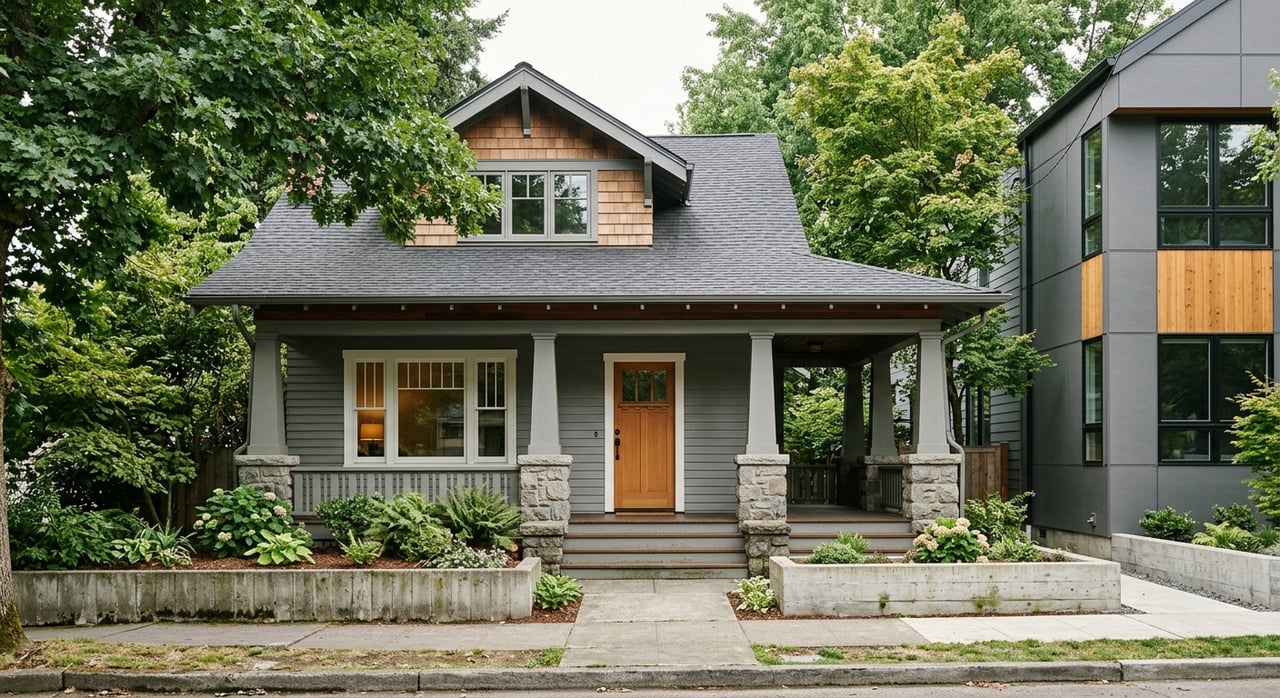
Wallingford has a different kind of appeal. City design guidance and historic-site records describe it as a classic streetcar suburb that developed along early 20th-century transit lines. The built environment is shaped by pre-World War II scale and detailing, including bungalows, street trees, and occasional backyard alleyways.
Its neighborhood center is anchored around North 45th Street and Wallingford Avenue North. That gives Wallingford a more corridor-based identity, with daily errands, restaurants, and local businesses tied more directly to a main commercial spine. If you like the idea of a traditional urban neighborhood with a strong center, Wallingford often delivers that feel.
The layout also tends to read as more regular and compact. Compared with Green Lake’s curved streets and lake-influenced geometry, Wallingford’s streetcar-suburb pattern can feel more consistently urban and a bit tighter-lotted. That predictability is part of the draw for many buyers.
Wallingford may suit you if
- You want a classic north Seattle neighborhood feel
- You value access to a strong commercial corridor
- You prefer a more consistent block pattern
- You are considering condos or townhomes in addition to houses
Comparing home types and inventory
If you are open to attached housing, Wallingford currently offers a deeper pool. Recent neighborhood market snapshots showed Green Lake with 4 condos and 15 townhouses for sale, while Wallingford had 14 condos and 20 townhouses. Realtor.com also showed more overall active inventory in Wallingford than in Green Lake.
That does not mean Green Lake lacks options. It simply suggests Wallingford may give you more choices if you want a condo or townhome, or if you are trying to balance location with budget and maintenance preferences. For buyers who want a detached home, both neighborhoods remain strong contenders, but inventory can feel limited and highly specific.
Lifestyle differences that matter
When buyers get stuck between these neighborhoods, lifestyle is usually the deciding factor. Both offer strong Seattle location appeal, but they support daily life in different ways.
Green Lake is built around outdoor use. The lake, loop, beaches, athletic areas, and community center create a recreation-forward setting that is easy to understand the moment you arrive. If walking, running, paddling, or simply being near open space is important to you, Green Lake often feels immediately compelling.
Wallingford is more corridor-oriented. Seattle Parks highlights Wallingford Playfield, and the Wallingford Steps connect North 34th Street to the Burke-Gilman Trail and Gas Works Park. The neighborhood also benefits from the Route 44 corridor, which links Wallingford to Ballard, Fremont, the University District, and the University of Washington on a high-ridership transit line.
A simple way to think about it
- Choose Green Lake if you want recreation and the park setting to shape your routine.
- Choose Wallingford if you want a classic residential neighborhood with stronger commercial street and transit connections.
How pricing compares
Price is close enough between Green Lake and Wallingford that broad rules can be misleading. Green Lake’s recent median listing price was about $998,000, and Wallingford’s was about $993,000. At the same time, Redfin’s March 2026 median sale data showed Green Lake at $940,000 and Wallingford at $1.0 million.
The practical takeaway is that Wallingford can sometimes hold slightly firmer value, with some sources showing a higher median sold price and higher price per square foot. Still, the overlap is significant. A well-updated condo, a dated bungalow, a newer townhome, and a character house on a different lot type can all shift the comparison quickly.
That is why buyers should think in ranges, not absolutes. In these neighborhoods, the type of home and its condition may matter just as much as the address.
Questions to ask before choosing
If you are deciding between the two, it helps to get specific about your daily life instead of focusing only on listing photos. A few questions can quickly clarify which neighborhood fits better.
Think about your routine
- Do you picture yourself spending regular time at the lake or park?
- Do you want errands and dining clustered around a stronger commercial street?
- Would you rather have a more varied block feel or a more regular urban pattern?
- Are you open to condos and townhomes, or do you want a detached house?
Think about the home itself
- How much renovation or updating are you comfortable taking on?
- Do you care more about architectural character or lower-maintenance living?
- Is lot shape, yard feel, or alley access part of your decision?
- Are you comparing homes by lifestyle value, not just square footage?
Which neighborhood is right for you?
There is no universal winner between Green Lake and Wallingford. Green Lake tends to pull buyers who want the lake, the loop, and a recreation-first setting close at hand. Wallingford often appeals to buyers who want bungalow-lined streets, a stronger attached-home selection, and easy connections along a well-established commercial and transit corridor.
If you are house hunting in this part of Seattle, the smartest move is to compare these neighborhoods through the lens of how you want to live, not just what is currently available. The right choice is usually the one that matches your routines, your housing priorities, and the kind of neighborhood texture that feels like home.
A thoughtful neighborhood comparison can save you time and sharpen your search. If you want calm, candid guidance on buying or selling in Green Lake, Wallingford, or nearby Seattle neighborhoods, connect with Dorothee Graham.
FAQs
What is the main difference between Green Lake and Wallingford homes?
- Green Lake homes are often tied to a lake-centered, recreation-focused setting with more variation in street layout, while Wallingford homes tend to reflect a classic streetcar-suburb pattern with a stronger commercial corridor and more consistent urban blocks.
Are Green Lake and Wallingford home prices similar?
- Yes. Recent market snapshots place both neighborhoods in a similar premium north Seattle price range, though Wallingford sometimes shows a slightly firmer median sold price depending on home type and current market conditions.
Does Wallingford have more condos and townhomes than Green Lake?
- Yes. Recent neighborhood inventory snapshots showed Wallingford with more condos and townhouses for sale than Green Lake, giving buyers a somewhat deeper attached-home selection.
Is Green Lake better for buyers who want outdoor access?
- For many buyers, yes. Green Lake is closely tied to the lake, the 2.8-mile loop, beaches, boating access, athletic fields, and the community center, which makes outdoor recreation a central part of daily life.
Is Wallingford better for transit and commercial access?
- Wallingford often stands out for corridor access, with its commercial center around North 45th Street and transit connections along Route 44 linking the neighborhood to Ballard, Fremont, the University District, and the University of Washington.
Should you choose Green Lake or Wallingford based only on price?
- No. Because prices overlap and can shift based on home type, condition, and exact location, it is usually more helpful to compare the neighborhoods by lifestyle, housing style, and the kind of daily routine you want.