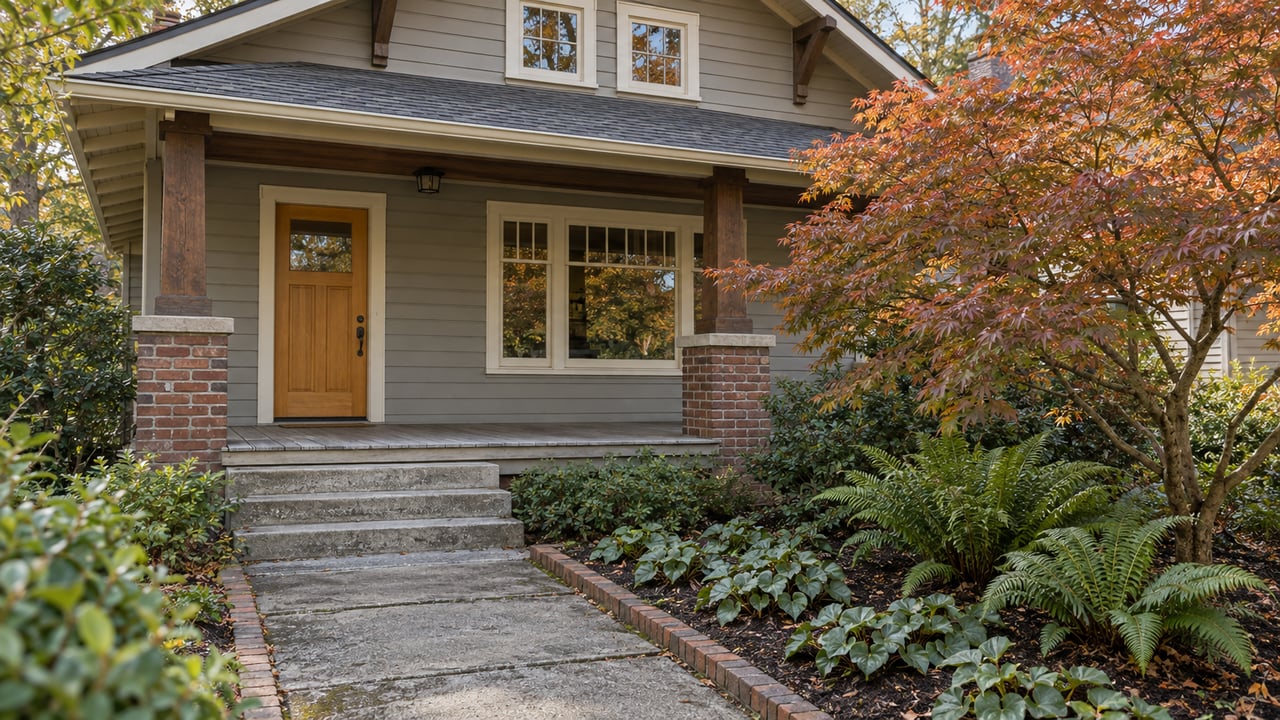
You're touring a 1920s house on N 40th Street, and the listing calls it a lot with "development potential." Since January, the city has allowed four homes on that lot. Does that mean a builder is lining up an offer next to yours?
For most of Wallingford this fall, the filings and the sales data say probably not. The rules have changed a great deal on paper. On the ground they have changed very little. Seattle's permanent middle-housing ordinance has been in effect since January, and that part is real. The bigger rezone that would have changed what gets built along Wallingford's bus corridors is on hold. And the permit filings show few developers putting money behind the new rules. When you're deciding what a lot is worth to you, that gap matters more than anything printed in a listing.
What took effect on January 21
The Seattle City Council adopted Ordinance 127376 on December 16, 2025, and the city lists January 21, 2026 as its effective date. It replaced the interim rules passed earlier in 2025. In Neighborhood Residential zones, which still cover most of Wallingford's house lots, the city's adopted standards allow the greatest of three numbers: four units per lot, six units near a major transit stop or when two units are affordable, or whatever the lot-area formula produces. Townhouses and stacked flats are both permitted forms.
That covers a lot of ground. The King County Assessor's 2026 report for Area 43, which covers Green Lake and Wallingford, says about 70% of the houses there were built before 1940. So an old house on an ordinary lot now legally carries the right to become several homes. Whether anyone will pay for that right depends on what happened next.
The rezone that would have mattered most is waiting on a court
The citywide fourplex rule was Phase 1. Phase 2, which the city calls Centers and Corridors, was always the change with more potential to reshape Wallingford. The Wallingford Community Council, a neighborhood group that has argued for changes to the proposal, summarized what the city's draft would do locally.
| Area | Zoning today | Phase 2 proposal | Status as of October 2026 |
|---|---|---|---|
| Lots facing N 40th St, Wallingford Ave N, N 35th St along routes 31 and 32 | Neighborhood Residential | Lowrise 3 | Proposed, on hold |
| Meridian Ave N between N 50th and N 56th, route 62 | Neighborhood Residential | Lowrise 3 | Proposed, on hold |
| Proposed Tangletown Neighborhood Center, roughly 400 lots | Neighborhood Residential | Lowrise 3 | Proposed, on hold |
| Most other Wallingford house lots | Neighborhood Residential | No change | Middle-housing rules in effect since Jan. 21, 2026 |
The council's description of LR3 shows why this matters for a buyer: five-story buildings, no cap on unit count, 80% lot coverage, and five-foot front setbacks. An apartment developer can pay far more for that kind of lot than for one limited to four townhouses.
None of that is in force. The city's zoning map from January 2026 is expressly labeled proposed. Then, on June 1, 2026, Washington's Court of Appeals, Division One, decided Friends of Ravenna-Cowen v. City of Seattle. The court held that the city's Hearing Examiner had wrongly dismissed appeals challenging the One Seattle Plan's final environmental impact statement, and it sent the case back for review in Superior Court. The appellants argue that the plan added housing capacity after the draft EIS without enough environmental analysis. The opinion did not rule on whether they are right. It also denied the appellants' request to delay Phase 2 and noted that supplemental environmental review, if it comes, could affect the unadopted rezone.
The council paused Phase 2 on its own. Its Comprehensive Plan page, last updated August 10, 2026, says the process is on hold because of ongoing litigation and that new meeting dates will likely come in early 2027. On KUOW's Soundside in July, Councilmember Eddie Lin said Phase 2 could slip into late 2026 or 2027. PubliCola reported that the council then voted 5-4 to remove the local Hearing Examiner appeal route for land-use legislation. Appeals to Superior Court or the Growth Management Hearings Board after legislation passes remain possible.
For a house on N 40th Street, that means the lot carries Neighborhood Residential rights today and a possible LR3 future on a timeline nobody has published. A builder pricing that lot has to discount for the wait and the risk. A household buying a place to live doesn't.
The filings show how little the new rules have been used
If builders thought the January rules penciled out, the permit pipeline would show it. The city's residential permit data offers a rough look. Since January 21, 2026, a query of Neighborhood Residential applications citywide returned 10 records totaling 13 units in the "Stacked 1 to 4 Units" group and one record of 17 units in "Stacked 5 or More." These numbers come with caveats. One project can appear in several records, and the city's permit dashboard warns that application-stage counts can be incomplete or wrong. Still, the trend is clear enough. Stacked flats, the form that turns one house lot into several full-size homes, barely appear in the record so far.
The wider pipeline is slow too. The Urbanist reported in August that permit applications in Seattle covered just 1,137 new units in the first half of 2026. That was down 30% from the same period in 2025, which had already fallen 38%. Bellevue logged at least 1,585 over the same months.
Architects saw the stacked-flat problem coming. In June 2025, under the interim rules, they told Cascade PBS that Seattle's standards would make a sample stacked-flat design 21% smaller than a comparable Spokane project, too small to work financially. They expected townhomes to dominate instead. The same reporting cited an 18-to-30-month timeline for townhome projects. That reporting predates the permanent ordinance, but the 2026 filings match it.
What the price data shows
If builders were competing hard for older Wallingford houses, prices for detached homes would show it first. They don't yet. NWMLS reports its King County numbers by map area, and area 705 is the closest read for this part of North Seattle. The MLS table lists it by number, not neighborhood, so it works as a regional signal rather than a Wallingford-only figure.
- September 2026, residential only: median closed price of $952,500, up 0.70% from $945,900 in September 2025. Closed sales fell to 120 from 128, and months of inventory stood at 3.76.
- August 2026, residential only: median of $930,000, down 0.61% from a year earlier, with 131 sales against 160 and 3.27 months of inventory.
- September 2026, houses and condos combined: median of $904,337, up 9.55%, on 146 sales, down 18.89%, with 4.45 months of inventory.
The combined figure jumped while the house-only figure barely moved. When sales fall that sharply, a change in which homes sold can move the combined median a long way. The residential-only line is the one tied to the lots builders would want, and it has been flat through late summer. With close to four months of inventory in September, buyers had more homes to choose from than the old Seattle bidding-war story implies.
The county's valuation tells a similar story. In its 2026 update for Area 43, the Assessor multiplied land values above $10,000 by 1.06 and included no adjustment tied to middle housing. The appraisal date was January 1, 2026, three weeks before the permanent ordinance took effect. The report also says an assessment cannot assume a use that existing zoning doesn't allow. Proposed LR3 on N 40th Street doesn't count, by the county's own method.
Reading a listing's zoning before you write the offer
"Development potential" in a listing doesn't tell you which set of rules it refers to. Before you decide how much of the price reflects a future you may never use, it helps to sort out three questions:
- What does the city map show today? Neighborhood Residential means the January 2026 rules apply now: four units, or six near major transit or with affordable units.
- Is the lot on the proposed Phase 2 map? If it faces N 40th, Wallingford Ave N, N 35th, or Meridian Ave N, or falls inside the proposed Tangletown center, LR3 is a possibility that depends on litigation, environmental review, and a council vote.
- Who has actually built under these rules nearby? The citywide filings since January are thin, and stacked flats are rare. A builder's interest in a specific lot is a fact you can learn during the transaction. A general claim of potential isn't.
That third question works in both directions. A seller near a corridor may hope the zoning adds value. A buyer may worry about five stories next door someday. Right now, both are reacting to a proposal, not to adopted law.
Questions buyers ask
Can a neighbor build four units next to a Wallingford house today? On most Neighborhood Residential lots, the January 2026 rules allow it. Whether it happens depends on the economics, and the 2026 filings suggest few projects have gotten that far.
When will the N 40th Street rezone be decided? No date has been set. The council says Phase 2 meetings will likely resume in early 2027, and the outcome of the environmental appeal could change the timeline.
Did the court strike down the plan? No. The Court of Appeals sent the environmental review appeal back for a hearing, did not rule on whether the EIS was adequate, and declined to order a delay of Phase 2.
If you're weighing a Wallingford house near one of the proposed corridors, I'm glad to go through the current zoning, the Phase 2 map, and nearby permit activity for that exact address with you before you settle on a number. Dorothee Graham works through this kind of detail with buyers and sellers every week. Let's Connect.
This article is general information, not legal, tax or financial advice. Consult a qualified professional about your situation.